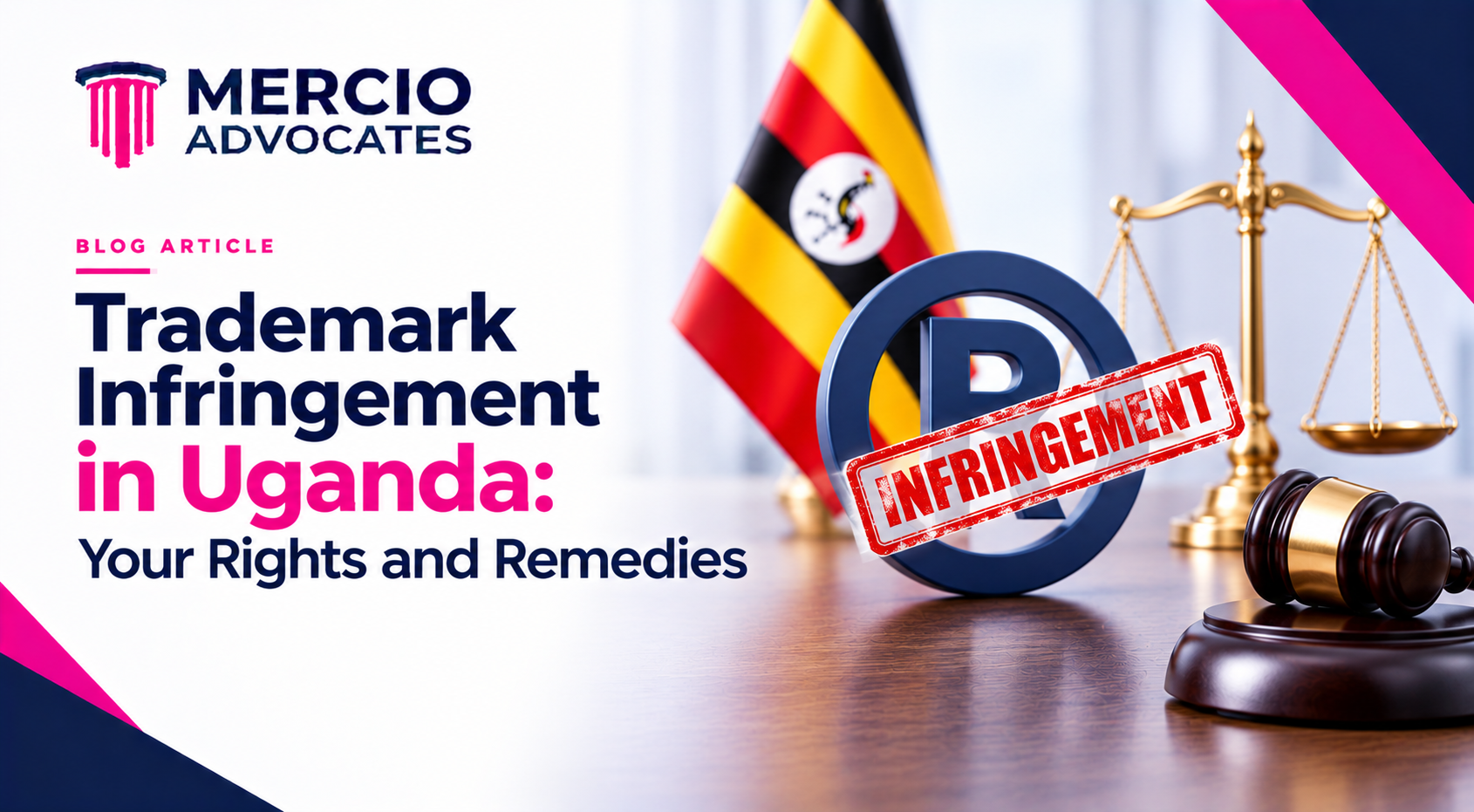
If someone uses your registered mark, or a confusingly similar one, without permission on the goods or services it covers, that may be trademark infringement in Uganda. Under the Trademarks Act, the owner can go to court for an injunction to stop the use and claim damages, and serious cases such as counterfeiting are also criminal offences. If your mark is not registered, you cannot sue for infringement, but you may have a claim for passing off.
Acting quickly and in the right order makes a real difference to the outcome. This guide explains what counts as infringement, the remedies available and the practical steps to take.
What is trademark infringement in Uganda?
Registration under the Trademarks Act, 2010 (now the Trademarks Act, Cap. 225 in the 2023 revised laws) gives the owner the exclusive right to use the mark for the registered goods or services. That right is infringed when a person who is not the owner, and who is not authorised by the owner, uses in the course of trade a mark that is identical to it or so nearly resembles it as to be likely to deceive or cause confusion, in relation to goods or services covered by the registration.
Typical examples include:
- a competitor selling products under the same or a very similar name or logo;
- counterfeit goods that copy your packaging and mark;
- a former distributor or franchisee who keeps using your brand after the agreement ends;
- a business using your mark in adverts, on signage or online in a way that suggests a connection with you.
Whether a mark is "confusingly similar" depends on the overall impression of the marks, how similar the goods or services are, and how customers buy them. These are questions of judgment, so get advice before you make allegations.
Registered and unregistered marks
The Act provides that no one may bring proceedings to prevent, or recover damages for, infringement of an unregistered trademark. The owner of an unregistered brand must instead rely on the action of passing off, which the Act expressly preserves. Passing off requires proof of goodwill, a misrepresentation likely to confuse the public, and damage. This is one of the clearest benefits of trademark registration in Uganda.
Check that your registration is still in force before you act. A registration that has not been renewed may have been removed from the register; our guide on how long a trademark lasts in Uganda explains renewals.
Remedies for trademark infringement
Civil remedies
Under the Act, an owner whose rights are being infringed, or are about to be infringed, may bring civil proceedings in court for:
- An injunction to stop the infringement. Where the harm is urgent, the court can be asked for an interim injunction while the case is decided.
- Damages for the loss caused. The Act makes clear that an injunction does not affect the claim for damages, and that a person harmed by infringement may claim damages whether or not the infringer has been prosecuted.
Courts can also make other orders that are available in civil cases, such as orders for costs. Your advocate will advise on what to ask for in your particular case.
Criminal offences
The Act creates several offences, including forging or counterfeiting a trademark with intent to defraud, selling or possessing for trade goods to which a falsified registered trademark is applied, and importing into or exporting from Uganda goods bearing a false trademark. For these offences the Act provides for a fine of up to 48 currency points, imprisonment of up to two years, or both, and the court may order infringing goods to be forfeited. Criminal action can be pursued by reporting the matter to the police, alongside or instead of a civil claim.
Step-by-step: what to do if your trademark is infringed
- Do not ignore it. Delay can weaken a request for urgent relief and allows confusion among your customers to grow.
- Collect evidence. Take dated photographs, buy samples and keep receipts, save screenshots of websites and social media, and note where and when the goods or services were offered.
- Confirm your rights. Obtain a copy of your registration and check the owner's name, the goods and services covered and the renewal status.
- Get legal advice on the strength of the claim, including whether the marks and goods are similar enough, and whether passing off also applies.
- Send a demand letter. Many cases settle once the infringer receives a formal letter asking them to stop, hand over or destroy infringing stock and give undertakings.
- Consider a criminal complaint where goods are counterfeit or are being imported or sold on a large scale.
- Go to court if needed. File a civil suit for an injunction and damages, and apply for an interim injunction where urgent.
- Prevent repeat problems. Monitor the market and the trademarks journal, and oppose similar applications when they are published.
If you are accused of infringement
If you receive a demand letter, do not ignore it, but do not admit liability either. Check whether the other party's mark is registered and in force, whether your goods or services really overlap, and whether you have earlier rights of your own. A measured response, sometimes involving a rebrand or a coexistence agreement, is often better than litigation.
Before you reply, gather the facts your advocate will need:
- when you first started using your name or logo, with evidence;
- whether you searched the trademarks register or registered anything yourself;
- where and how you sell, and to which customers;
- how much stock, packaging and marketing material carries the disputed mark.
Licences and distributors
Many disputes start with a business relationship that has ended. Written licence and distribution agreements that define how your mark may be used, and what happens when the relationship ends, make enforcement much easier. It is worth reviewing your existing agreements now, before a dispute arises, to check that they deal with brand use, quality control and the return or destruction of branded materials. Where a licensee breaks the agreement, you may have claims both for infringement and for breach of contract; see what happens when a contract is breached in Uganda.
How Mercio Advocates can help
Our business law team protects brands through intellectual property advice and represents clients in business disputes through litigation, mediation and arbitration. We can assess your claim, send demand letters, negotiate settlements, coordinate with the police and pursue civil claims for injunctions and damages. Call +256 785 390 207, email info@mercio.org or book a consultation about your brand.
This article provides general information about trademark law in Uganda and is not legal advice. Every infringement case depends on its facts, so please contact Mercio Advocates for advice on your situation.