
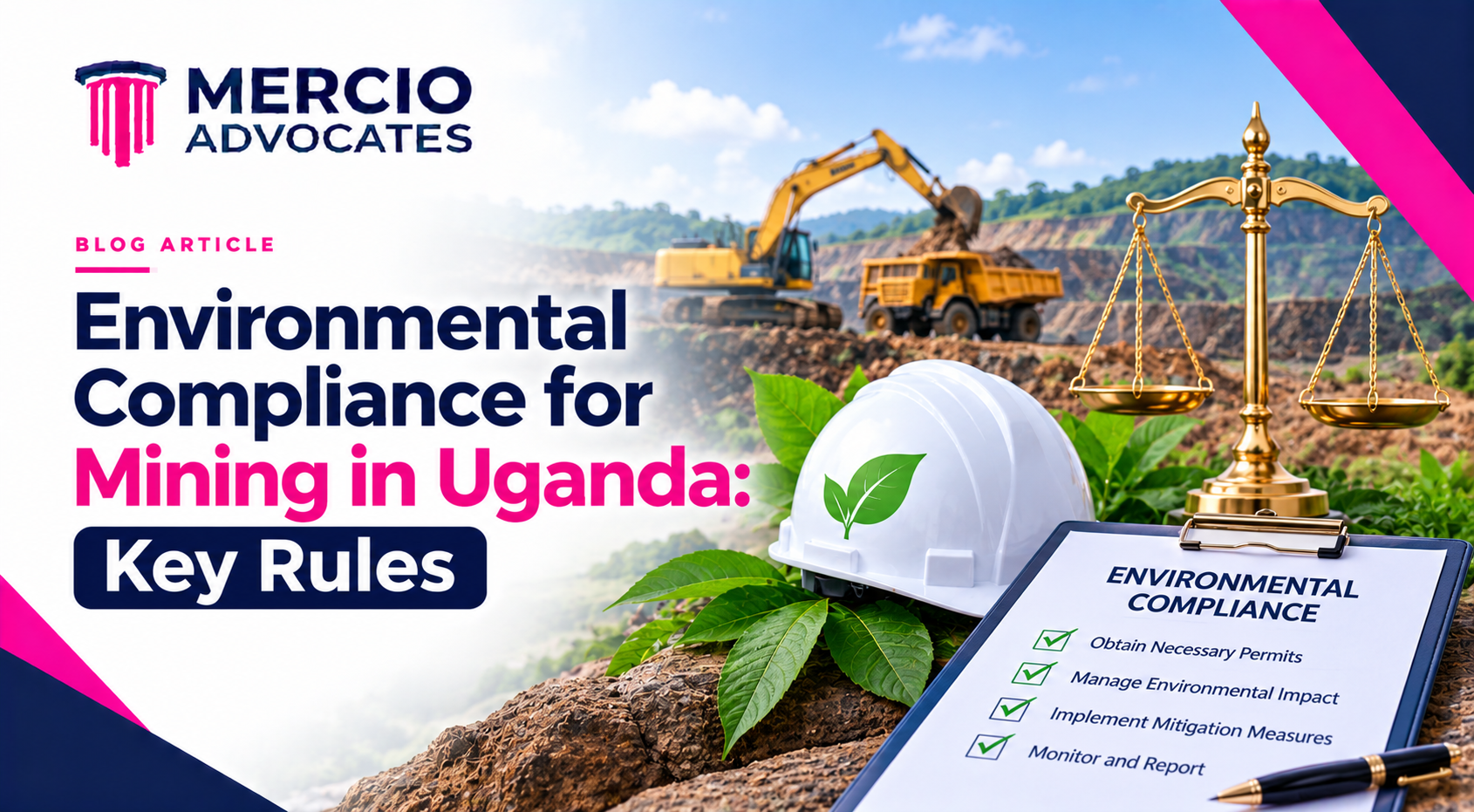
Environmental compliance for mining in Uganda starts with an environmental and social impact assessment (ESIA) approved by the National Environment Management Authority (NEMA) under the National Environment Act, 2019, which mining licence applications depend on. It continues through the life of the mine: preventing pollution, meeting health and safety standards, providing a financial guarantee where required, and rehabilitating land under an approved decommissioning or closure plan.
Environmental failures can stop a project, lead to prosecution and damage community relations. They also affect financing, because lenders and buyers increasingly check environmental records before committing money. This guide explains the main obligations and a practical compliance approach for licence holders, contractors and investors.
The legal framework
- The Mining and Minerals Act, 2022. Section 4 requires everyone acting under the Act to give effect to the environmental principles in the National Environment Act, 2019. The Act also prohibits pollution and requires holders to preserve the environment and meet occupational safety and health standards.
- The National Environment Act, 2019, which sets up NEMA and the system of project briefs, environmental and social impact assessments, audits and environmental guarantees.
- The National Environment (Environmental and Social Assessment) Regulations, 2020 (S.I. No. 143 of 2020), which set out the ESIA process step by step.
- The National Environment (Audit) Regulations, 2020, which apply to projects after the first year of operation.
Environmental compliance for mining in Uganda at licence stage
The Mining and Minerals Act, 2022 links licensing directly to environmental approval:
- exploration work is tied to an approved ESIA (section 50);
- a large scale mining licence application must be accompanied by an ESIA under the National Environment Act, 2019, together with a feasibility study (section 60);
- a medium scale application must describe the effects on the environment and the local population and propose mitigation and compensation measures (section 74);
- a small scale application must be accompanied by a certificate of approval of an ESIA (section 86).
The ESIA process step by step
Under the 2020 Regulations, the process generally runs as follows:
- Project brief. The developer submits a project brief describing the project and its likely impacts. NEMA decides within 30 days of a complete brief whether a full ESIA is needed.
- Scoping and terms of reference. The developer identifies key issues and stakeholders and prepares terms of reference, which NEMA reviews.
- ESIA study and consultation. Registered practitioners assess impacts and alternatives and consult stakeholders, with at least seven days' notice of consultation meetings.
- ESIA statement. The developer submits the signed statement with the prescribed fees.
- Review and public participation. Lead agencies comment, NEMA may invite public comment and site visits, and a public hearing may be held at the developer's expense.
- Decision. NEMA decides within 60 days of a complete statement to approve, defer or reject.
- Certificate of approval. The certificate is valid for the period NEMA sets, not exceeding ten years, and lapses if the project does not start within 12 months.
Obligations during operations
- Comply with ESIA conditions and the environmental and social management plan, including on water, waste, dust, noise and chemicals.
- Environmental audits. After the first year, operations are subject to environmental audits under the Audit Regulations.
- Financial guarantee. Large scale licence holders must obtain a financial guarantee in accordance with the National Environment Act, 2019 (section 70(1)(h)), and the Minister may require financial security under section 7.
- Health and safety. Operations must meet occupational safety and health standards, and employing children below the minimum working age is an offence.
- Community and cultural heritage. Holders must respect local communities' rights and customs and manage impacts on water sources and farmland.
- Chemicals. Mercury and cyanide use in gold processing require particular care, safe storage and handling, and compliance with environmental conditions.
Rehabilitation, decommissioning and closure
Large scale licence holders must carry out rehabilitation of the licence area in accordance with a decommissioning plan approved by NEMA (section 70(1)(j)). Medium scale holders must carry out environmental and social assessment, rehabilitation, reclamation and restoration of mined-out areas under the mine closure plan, in line with the National Environment Act (section 81). Planning for closure from the start, and budgeting for it, avoids large liabilities at the end of a project and makes the project more attractive to lenders and buyers.
Working with NEMA and other agencies
Environmental compliance involves several bodies. NEMA issues ESIA approvals and enforces the National Environment Act, lead agencies such as the Directorate of Geological Survey and Mines review assessments within their sectors, and district environment officers monitor activities locally. Keeping each informed, responding to inspection findings promptly and recording all correspondence builds a compliance history that helps when renewals, variations or disputes arise.
Consequences of non-compliance
Failing to meet environmental, health and safety standards is an offence under the mining law, and the National Environment Act gives NEMA enforcement powers, including improvement and restoration orders. Breaches can also lead to suspension or cancellation of licences, civil claims by affected people and loss of community support. For more on how these claims are handled, see our guide on resolving mining disputes in Uganda.
Environmental issues in mining transactions
Investors and lenders look closely at environmental compliance. When buying a licence or a share in a mining company, check that the ESIA certificate is valid and transferable, that conditions have been met, that audits were filed and that there are no pending NEMA orders or community claims. Unresolved environmental liabilities usually pass with the project, so they should be priced into the deal or covered by warranties and indemnities.
A practical compliance checklist
- Map every environmental approval and condition that applies to the project.
- Assign a responsible manager and a budget for compliance.
- Build a calendar of audits, reports, renewals and guarantee updates.
- Train staff and contractors on chemicals, waste and safety.
- Monitor water, air and land, and keep records.
- Engage the community and handle complaints promptly.
- Review the closure plan and costs every year.
For the licences that trigger these obligations, read mining licences and permits in Uganda.
How Mercio Advocates can help
Our mining law team advises on applicable environmental regulations and on strategies to reduce environmental impact and support sustainable, socially responsible mining. We review ESIA conditions and compliance gaps, advise on guarantees and closure obligations, and act in enforcement matters and environmental claims.
Visit us at Plot 10 Luwum St, California Plaza, Kampala (Mon-Fri 8:00-18:00, Sat 9:00-13:00), call +256 785 390 207, email info@mercio.org, or book a compliance review.
This article is general information about Ugandan mining law and is not legal advice. The law, regulations, fees and Ministry procedures change, and every project turns on its own facts. For advice on your situation, contact Mercio Advocates on +256 785 390 207 or info@mercio.org.